
IDEC协作安全/安全2.0 | 中国

企业社会责任要求与新安全理念
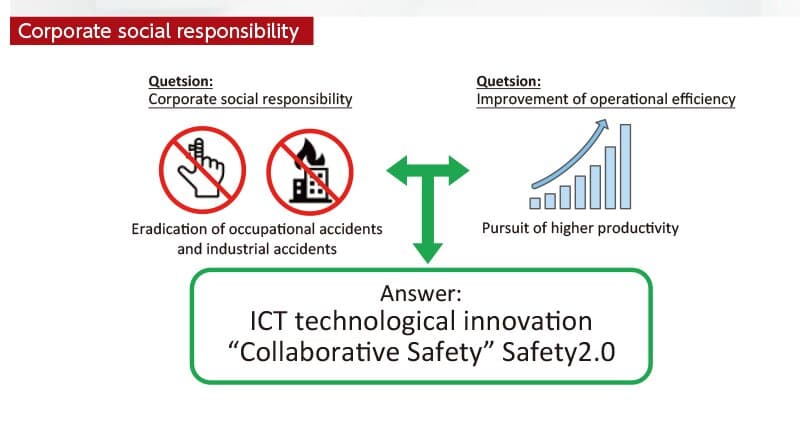
最新的信息通信技术有助于实现基于信息通信技术的现代智慧社会。不仅通过提高我们日常生活的效率,而且还通过提高企业经营者的经济效率,例如工厂的制造业。
需要有一种技术,能够确保与这种技术进步相一致的安全。
IDEC正致力于用下一代安全技术消除职业和工业事故。我们正在推广“协作安全”的概念,通过提高生产率来提高管理效率,并为此推出“安全2.0”技术措施。
安全的定义
“安全”在国际标准中被定义为“免于不可容忍的风险”(ISO/IEC指南51)。
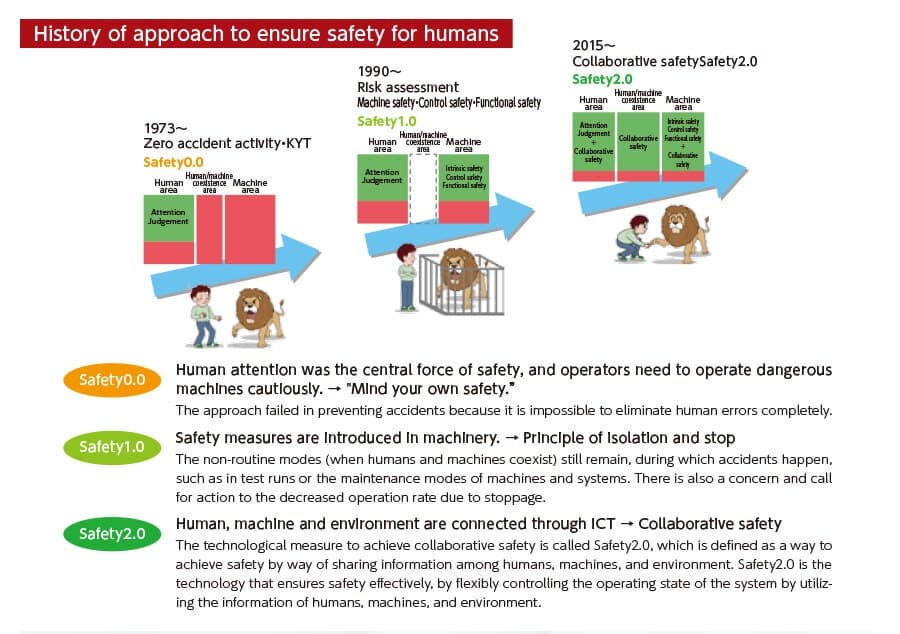
到目前为止,如下图所示,确保人类安全的方法已经从依靠人的注意力(安全0.0)过渡到将人与机器分开或停止机器(安全1.0)。此外,随着技术创新的进步,“协作安全/安全2.0”被提倡为一个安全概念,在这个人与机器共存的环境越来越多的新时代,这是必要的。
“协作安全/安全2.0”
协作安全是一种安全系统设计概念,旨在通过人(人文科学)、机器(科学)和组织/环境(社会科学)之间的协作信息共享来确保安全。它是在日本发起的,其基础是综合利用有关工作场所相关事项的信息,这些事项过去是分开处理的,但现在由于信通技术的进步可以加以综合处理。安全2.0被定义为利用ICT的力量实现协作安全的技术措施。安全可以通过有效和高效的方式,协作和整体地整合和共享人、机器和环境的信息来实现。
“协作安全/安全2.0”可实现的四件事
安全无停机
通过控制机器的速度或根据工人的能力定义操作区域,安全2.0使确保安全和生产力成为可能。
例如,通过识别工人的技能水平和健康状况,并实现最佳控制以防止停机,同时确保安全,可以提高安全性和生产率。
安全可视化
安全2.0利用信息通信技术,通过监测工人的身体状况和设备/系统的状况,可以直观地识别安全状态,以便在发生异常情况时采取适当的措施。
协作自动防故障装置
传统上,故障安全是一种系统设计概念,即在部件、机器发生故障时,系统本质上以最安全的故障模式结束。“协作安全/安全2.0”系统旨在实现一种新型的故障安全设计实践,该设计实践使用ICT来整合机器、人员和环境的条件。
减少系统占用空间
在人机共存的环境中,由于不再需要安全围栏,因此可以通过确保工人的安全来减少系统/机器的占地面积。
CSL(协作安全级别)
在“机械安全/安全1.0”中,有一个称为“性能水平(PL)”的指标。该指标根据单位时间内危险故障的概率,并根据机器中风险继承的大小,对机器中执行安全功能的安全相关控制系统的可靠性水平进行分类。
IDEC认为“协作安全/安全2.0”将需要一个新的索引。CSL(协同安全指数),如表1所示,表示安全和生产力的最佳水平。
在构建“协作安全/ 安全2.0”体系后,利用该指标来确认系统的协作安全水平,同时识别缺失的要素,以探讨未来提高安全水平的方向和可能性。
| Safety2.0 Requirements | Collaborative Safety Level (CSL) Requirements | ||||
|---|---|---|---|---|---|
| Item | Details | CSL 1 | CSL 2 | CSL 3 | CSL 4 |
| Secure means to avoid hazardous situations in areas used by people | Utilizing information about people, control machines to avoid hazardous situations | Utilizing information about people, control machines to avoid hazardous situations | Control human and machine conditions in real time for optimal safety | ||
| Criteria | Information (ICT) connects each component, such as people, things, and environments | Communicating information about people to things | By connecting people and things, information about people is transmitted to things and machines are controlled. | By connecting people and things, the state of things is transmitted to people, who are instructed to avoid certain actions. | By connecting people and things (or environments), optimal conditions for both can be controlled. |
| Monitoring and dissemination of risk information (hazard and safety information) | Monitoring of hazard information, dissemination of information | Confirm (reduce) risk to people by disseminating the behavior and condition of people. | Confirm (reduce) risk to machines by disseminating operation information and accumulated information about things. | Share and confirm (reduce) risk to a variety of elements, including people, things, and environments. | |
| Receiving risk-related information and providing guidance that leads to safety through either autonomous or heteronomous control | Avoid hazardous situations through human action/operation (heteronomous control). | Implement control of things to avoid hazardous situations, through human action/operation (heteronomous control) or status confirmation (autonomous control). | Disseminate and analyze operation information and accumulated information about things, and provide guidance to avoid situations that are hazardous to people through human operation (heteronomous) or machine control (autonomous). | Analyze and learn about various elements, including people, things, and environments, implement optimal risk reduction, and avoid hazardous situations autonomously. | |
| Contribute to productivity |
For new equipment: Achieve target production capacity, or improve
capacity For existing equipment: Maintain production capacity, or improve capacity |
||||
| Communication/control technology | Signal level | Data transmission | Two-way interactive communication | Use of AI | |
实现“协作安全/安全2.0”的四个要素
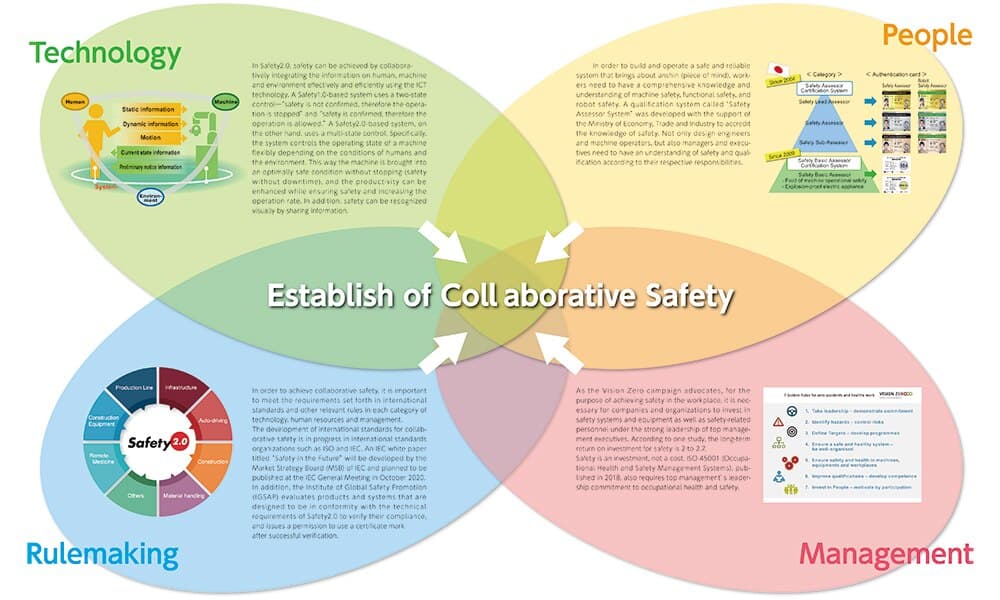
“协作安全/安全2.0”并不仅仅依赖于技术。它通过全面整合四个要素——技术、人力资源、管理和规则制定,确保高水平的安全和生产力。
通过最高管理层的强有力领导,将促进安全作为重要的企业战略,现在可以在工人和危险并存的环境中确保新的安全和高水平的生产力。
采用“协作安全/安全2.0”的产品和系统
通过使用“协作安全/安全2.0”技术,可以同时实现安全与生产力,这是传统机器安全难以单独实现的。
IDEC提出以下“协作安全/安全2.0”产品和系统。
▪“安心传感器”
一种利用电容原理为协作机器人检测人的传感器,以及一种非接触式停止机器人和机器的方法
▪“紧急停止辅助系统”
一种可穿戴的停止开关,可以机械地停止具有紧急停止辅助功能的机器。